Diagnose First, Fix Right
Septic Tank Repair Covington KY
Baffles, pumps, pipes, lids, and risers — diagnosed first, quoted plainly, permitted through NKY Health. And an honest answer when the field is the real problem.
- Full diagnosis before any repair quote
- Baffles, pumps, pipes, lids, and risers
- Permitted through NKY Health where required
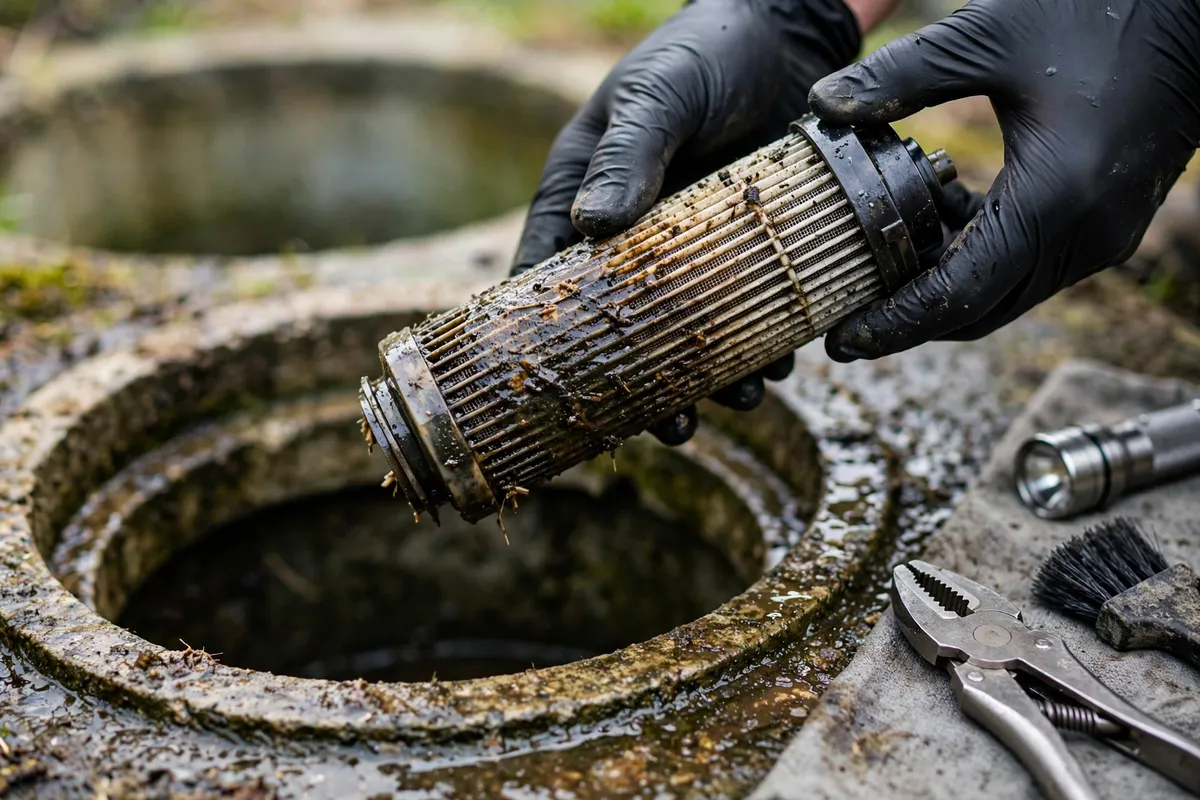
When the drains gurgle, the yard smells, or sewage is backing up where it should not be, septic tank repair covington ky is a search people make in a hurry — and the first thing to know is that not every backup means the tank is the problem. A full tank, a dead baffle, a failed pump, or a clogged field all look similar from inside the house, and each one has a very different price tag.
Most residential repairs land between $250 and $1,500: baffles, effluent filters, pumps, pipes, lids, and risers. The outlier is the absorption field — field work runs from $400–$5,000 for rejuvenation up to $3,000–$15,000 for replacement. Below is what each repair actually involves, what it runs, and how the legal repair process works in Kenton County.
Septic Tank Repair Covington KY: What a Repair Visit Actually Covers
A proper repair visit starts with diagnosis, not parts: we open the tank, check the baffles and effluent filter, test the pump and floats if you have them, and trace the lines toward the field. Only then do we quote the fix — because half of what looks like a tank problem turns out to be something else entirely.
Most residential repairs fall into a familiar list: baffles and filters, effluent pumps, broken or root-choked pipes, cracked lids, and buried access points that need risers. Minor repairs typically run $250–$1,500. The outlier is the absorption field — field work is a different category of money, and we will say so plainly when that is what you are looking at.
- Full system diagnosis before any repair quote
- Baffles, filters, pumps, pipes, lids, and risers
- Straight answer when the field — not the tank — is the problem
- Repairs permitted through NKY Health where required
Baffles and Effluent Filters: The Cheap Fix That Protects the Expensive Part
Baffles and the effluent filter are the gatekeepers inside your tank — they keep solids out of the absorption field, and when they fail, solids migrate downstream and start killing the field.
Replacing a baffle typically runs $300–$900. An effluent filter cleanout is often handled during a pump-out; a replacement filter costs little next to what it protects. If your system is backing up and the tank has not been opened in years, this is the first place we look — it is the cheapest repair with the biggest downstream payoff. Filters should be checked every few years; a clogged filter alone can mimic a full system failure.
Effluent Pumps: Repair the Pump or Replace It?
If your system lifts wastewater uphill to a mound or a raised field, it has an effluent pump — and when that pump quits, the alarm sounds and the tank level starts rising.
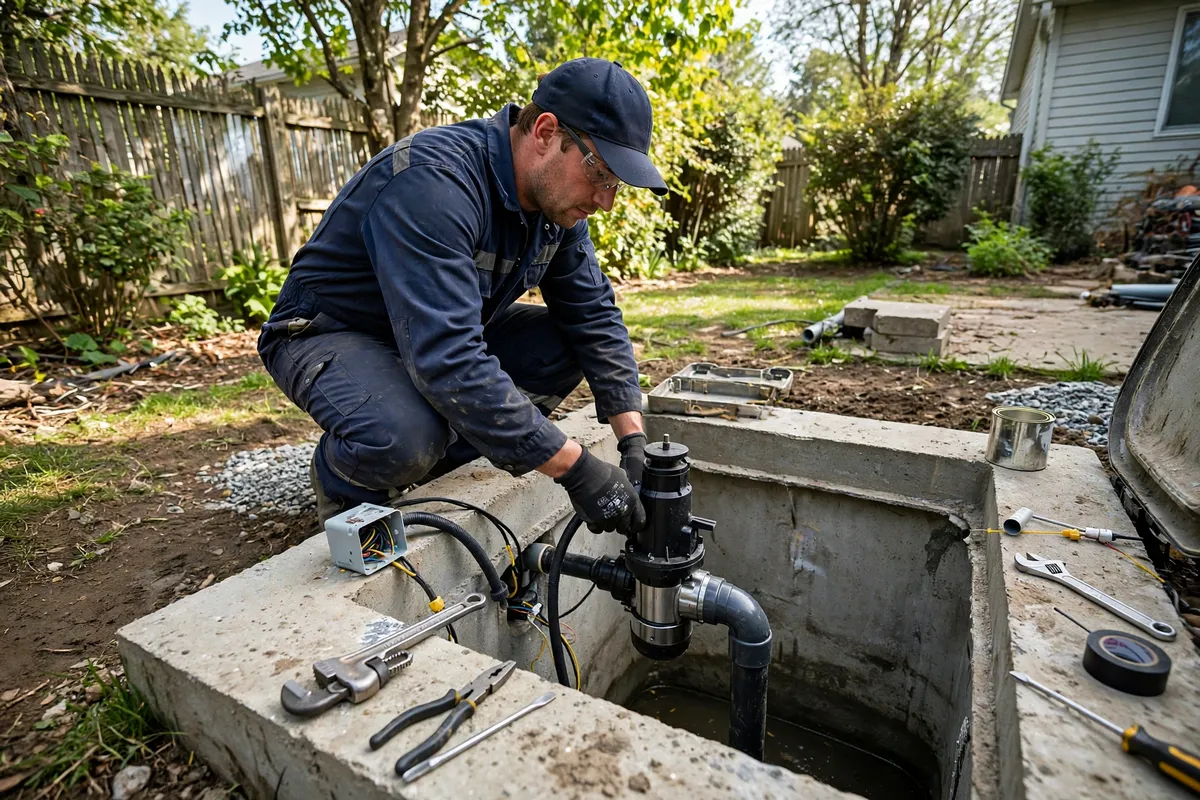
A pump repair (floats, wiring, seals) typically runs $250–$400. A full pump replacement runs $800–$1,400 depending on pump size and chamber depth. The rule of thumb we give homeowners: repair the pump once; if it fails again within a couple of years, replace it — a second repair call usually costs more than the difference. If your alarm is sounding right now, see our emergency pumping help page for what to do before we arrive.
One company, every septic job: Covington Septic Pumping serves all of Covington, KY.
Pipes and Lateral Lines: Breaks, Roots, and Belly Sags
The line from the house to the tank and the laterals feeding the field take real abuse — shifting soil, tree roots, and heavy vehicles driving over shallow pipe.
Simple pipe repairs start around a few hundred dollars; full lateral excavation and replacement typically runs $1,000–$4,200 depending on depth, length, and how much has to be opened up to reach it. Roots are the usual suspect in older Covington neighborhoods with mature trees — we find them, cut them out, and repair the section so they do not grow straight back in. Camera inspection ($125–$500) pinpoints the break before anyone digs, which keeps the excavation — and the bill — as small as possible.
Lids and Risers: Stop Paying to Dig Up Your Own Yard
If your tank lid is buried two feet down, every service visit starts with a digging charge — and that charge repeats every single time anyone needs in.
A cracked lid replacement runs $150–$500. A riser — the extension that brings the access port up to grade — runs $300–$600 installed per riser, and it pays for itself by deleting the dig fee from every future pump-out and inspection. We recommend risers on nearly every tank we open that does not have them; it is the rare upsell that genuinely saves the homeowner money year after year.
Drain Field Trouble: When Rejuvenation Works and When It Does Not
When the absorption field is only partly clogged, rejuvenation — air injection or hydro-jetting that breaks up the biomat — can buy it more years, typically $400–$5,000. When the field is fully failed, the only fix is excavation and replacement at $3,000–$15,000.
Here is the scenario we hear weekly: 'We had it pumped 13 months ago and it is backing up again.' Pumping empties the tank; it does not unclog a field. If water runs back into the tank from the drain lines after a pump-out, the field is not absorbing — and no amount of pumping will change that. We test for exactly this before quoting field work, so you never pay for a pump-out to treat a field problem.
The Legal Repair Process in Kenton County
In Kenton County, septic repairs go through the Northern Kentucky Health Department in three steps: contact a certified installer to propose the corrections, complete a repair site evaluation form, and obtain a repair permit.
That process exists because a bad repair can contaminate groundwater — and in parts of Kenton County, failing systems are already a documented public issue, with state money spent to extend sewers and eliminate failing septics in Independence, Ludlow, and Taylor Mill. A permitted repair protects your property value and keeps you on the right side of the health department if you ever sell. We handle the forms and the scheduling; you approve the plan.
Tank Problem or Plumbing Clog? How to Tell Before You Call
One slow drain is usually a plumbing clog; every drain slow at once — toilets gurgling, showers backing up, sewage odor in the yard — points at the septic system.
If every drain in the house is slow and the toilets gurgle when the washer runs, that is the pattern behind most septic tank repair covington ky calls — whole-house symptoms mean the system, not a single pipe. Check the easy things first: a tripped pump breaker, a filter that has never been cleaned, or a tank that is simply overdue for pumping. Then call — telling us 'whole house' versus 'one fixture' helps us dispatch the right fix the first time.
- Single slow fixture → likely a plumbing clog
- All drains slow plus gurgling → likely the septic system
- Sewage backing into tubs or showers → call now
- Wet spots or sewage odor in the yard → the field may be failing
Repair or Replace? The Math We Walk Homeowners Through
The honest rule: when repair estimates pass half the cost of a new system — or the system has failed twice in a few years — replacement usually wins on math alone.
Age is the second half of the math: a conventional system lasts about 20 to 30 years, so a repair on a 30-year-old tank and field buys time, not a new life. The question to ask before paying for another repair is whether skipped pump-outs have already let solids into the field - pumping empties the tank, it cannot unclog a failing field, and that is the test that decides repair against replacement.
A new conventional gravity system runs $3,000–$8,000; engineered designs run $8,000–$20,000-plus. If you are staring at a $4,000 field repair on a 30-year-old system, that money buys more life as part of a new install. If you are weighing septic tank repair covington ky against starting over, we will put both ranges on the table in one visit — new system installation is the other half of that conversation, and we will tell you straight which side we would take.
Diagnose first
What Breaks, What It Costs, and When to Stop Repairing
A competent repair call is a diagnosis before it is a repair. On site the sequence runs the same way every time: open and pump the tank and read the sludge, scum, and liquid level; check the inlet and outlet baffles and the effluent filter; run the building sewer line, camera if it needs one; test the pump, floats, and alarm; then walk the distribution box and the field. Each step crosses a suspect off the list, cheapest parts first — because the cheapest parts in the system protect the most expensive one. A septic system inspection is that same sequence done formally, and it is where every honest repair quote starts.
Baffles and the effluent filter: the cheapest insurance on the property
Start with the baffles and the filter, because they guard the field. The outlet baffle keeps solids in the tank and the effluent filter strains what gets past it; when either fails, solids migrate into the drainfield and start clogging it. A missing outlet baffle or a clogged filter can also mimic a much bigger failure, right down to slow drains through the whole house. The money is small: baffle replacement runs $300–$900 in national cost data, and an effluent filter replacement runs $200–$300 — the filter part itself is only $50–$200 of that. This is the first place we look, every time.
Pumps, floats, and alarms: usually not the pump
Most pump failures turn out to be electrical or control problems, not the pump itself. On dosed, mound, and advanced-treatment systems the fault is typically a float switch, a wire, or the control panel — which is why a pump repair runs $250–$1,000 nationally with the average repair down at $250–$400. When the pump itself is done, replacement runs $800–$1,400 for a standard effluent pump; grinder pumps run higher, up toward $3,000. The high-water alarm is the part that warns you — a new alarm averages about $500 — and when it sounds, the level in the chamber is higher than it should be: cut the water use and make the call.
Risers and lids: the fix that makes every later fix cheaper
A riser brings the tank’s access opening up to the surface, and it runs $300–$600 per riser installed. After that, no visit ever starts with a digging charge again — a crew opens the lid, does the work, and closes it back up. The lid itself is the cheapest part on this page: $30–$70 for the part alone, $150–$500 installed. If your lids are buried, the riser conversation is worth having while the tank is already open for something else; it is the one spend that keeps paying you back at every pump-out, inspection, and repair after it.
Lines and the distribution box
Between the house and the tank, the building sewer line takes the hits: roots, a belly where the pipe has sagged, or a collapse on an older line. A camera run, $250–$1,175 in the national repair guides, settles which one it is before anybody digs. Line repair itself runs $1,000–$4,200 — about $1,500 on average, or $50–$250 per linear foot. Past the tank, the distribution box splits the flow evenly across the field. Uneven distribution, ponding, surfacing effluent, or a lush green strip over one part of the yard says the flow is not splitting the way it should. A distribution box replacement runs $500–$1,500.
Cracks: the water test decides seal or replace
A cracked tank is judged by a water test, not by the crack alone. After pumping, the liquid level tells the story: if the level drops, effluent is leaking out of the tank; if it rises, groundwater is pushing in. A hairline crack above the waterline that still holds water can often be sealed — crack sealing and patching runs $500–$4,000. A crack that leaks in either direction is structural, sealing rarely holds on it, and the honest call is replacement: a new tank that reuses a sound field runs $3,000–$9,500.
The drainfield: rejuvenation buys time, replacement ends it
The field is the one part that cannot be repaired back to health. Rejuvenation — soil fracturing or jetting, $400–$5,000 all-in, with jetting alone at the $400–$900 end — can buy a tired field more time, and sometimes that is exactly the right spend. But a failed field gets replaced: $3,000–$8,000 for a partial replacement of one or two trenches, $3,000–$15,000 for a full field, with the national guide average around $7,000. Ponding, surfacing effluent, and lush strips over the field are the signs that move the conversation from parts to field money.
What the common repairs cost
Pulled together, here is the national picture for the repairs above. Excavation depth and access move every number on the list — a shallow tank with clear access sits at the low end, a deep tank under a patio at the high end — which is why the diagnosis comes before the quote, not after it.
| Repair | Typical range | When it applies |
|---|---|---|
| Baffle replacement | $300–$900 | Inlet or outlet baffle failed, rotted, or missing |
| Effluent filter replacement | $200–$300 | Outlet filter clogged or damaged (part alone $50–$200) |
| Effluent pump repair | $250–$1,000 | Most faults are floats, wiring, or controls |
| Effluent pump replacement | $800–$1,400 | The pump itself has failed; grinders run higher |
| High-water alarm (new) | ≈$500 | Average installed price for a new alarm |
| Riser, per riser installed | $300–$600 | Brings a buried access opening up to grade |
| Tank lid, installed | $150–$500 | Cracked or unsafe lid (part alone $30–$70) |
| Sewer / septic line repair | $1,000–$4,200 | Roots, bellies, collapse — or $50–$250 per linear foot |
| Distribution box replacement | $500–$1,500 | Box settled, cracked, or splitting flow unevenly |
| Crack sealing / patching | $500–$4,000 | Hairline cracks above the waterline only |
| Drainfield rejuvenation | $400–$5,000 | Soil fracturing / jetting to buy a tired field time |
| Full drainfield replacement | $3,000–$15,000 | Failed field; guide average ≈$7,000 |
| Tank replacement | $3,000–$9,500 | New tank reusing a sound existing field |
National ranges: Angi 2026 septic repair-cost data and HomeAdvisor component pricing (via Angi’s guides); rejuvenation and field figures also from SepticCalculator and EngineerFix. These are national ranges, not a quote — yours is set after the diagnosis, before work starts.
The five component repairs from the table, drawn to scale against a $1,500 top end. The pattern to notice: the parts that protect the field cost hundreds; the field itself costs thousands.
Repair or replace? The rules we actually use
The 50% rule. When a repair estimate passes roughly half the cost of a new system, replacement is usually the smarter money — especially on an older system in heavy soil, where a field repair is often just a band-aid.
Age. Drainfields are built for roughly 20–30 years of service. Past about 20 years with repeat problems, replacement usually costs less over the next decade than a string of repairs that each buy a year or two.
The tank’s material. Concrete tanks run 40–50 years, though hydrogen-sulfide gas can corrode them over time. Plastic runs 30–40 years; fiberglass 30–50 and is corrosion-proof, but it has to be anchored so it cannot float in a high water table. Steel runs only 15–20 years and is obsolete — a rusting steel tank is a replacement candidate, not a repair.
The field. A failed drainfield does not get repaired back to health; rejuvenation buys time and replacement is the fix, on a reserve area if the lot has one. Run those four checks against your system and the answer usually names itself — and when it is replacement, we put that number next to the repair number, the new system installation ranges included, so you are deciding on math instead of pressure.
Common questions
Frequently Asked Questions
Because pumping empties the tank but cannot unclog a failing absorption field. If water flows back into the tank from the drain lines after a pump-out, the field is not absorbing — that is a field problem, not a tank problem, and it needs field work or replacement, not another pump-out.
One slow drain is usually plumbing. Every drain slow at once, toilets gurgling, or sewage backing up into the lowest fixture — that is the septic system. Quick check: if the problem hits the whole house at the same time, start with the septic.
Usually, yes. Unusually lush grass over the field area means nutrient-rich effluent is surfacing instead of percolating down — a classic sign the field is struggling. Get it checked before it turns into surfacing sewage.
It can prevent the damage, and sometimes stop it from getting worse. The baffle keeps solids in the tank; once it fails, solids flow to the field and clog it. A $300–$900 baffle replacement protects a field that would cost thousands to replace.
Most companies charge a dig fee to expose a buried lid, and it repeats every visit. Installing a riser ($300–$600) brings access to grade and deletes that fee from every future service. Ask for risers at your next pump-out.
In Kenton County, yes for most repairs beyond basic maintenance. The NKY Health process is: a certified installer proposes the fix, you complete a repair site evaluation form, then a repair permit is issued. We handle that paperwork as part of the job.
Compare the repair range against replacement ($3,000–$8,000 conventional; $8,000–$20,000+ engineered) and factor the system's age — past 25–30 years with a failed field, replacement usually wins. We quote both so you can see the math side by side.
Usually not. Most pump failures turn out to be electrical or control faults — a float switch, the wiring, or the control panel — rather than the pump motor itself. That is why pump repairs run $250–$1,000 nationally, with the average repair around $250–$400. Replacement is the call when the pump itself has failed: $800–$1,400 for a standard effluent pump, with grinder pumps running higher. The diagnosis comes first, because swapping in a new pump fixes nothing when the float was the problem.
Sometimes — the crack and a water test decide it. After pumping, watch the level: a level that drops means effluent is leaking out, and a level that rises means groundwater is pushing in. A hairline crack above the waterline that still holds water can often be sealed, and crack sealing and patching runs $500–$4,000. A crack that leaks in either direction is structural; sealing rarely holds on it, and replacement is the honest recommendation.
Drainfields are built for roughly 20–30 years of service. Past about 20 years with repeat problems, replacement usually costs less over the next decade than a string of repairs. The other rule of thumb is the 50% rule: when a repair estimate passes roughly half the cost of a new system, put the money toward the new system — especially on an older system in heavy soil, where a field repair is often only a band-aid.
Ready to Schedule Your Septic Service?
Call Covington Septic Pumping today. We show up on time, pump it fully, clean up, and honor the quoted price.
Call (615) 413-1746