Covington, KY Septic Service
Septic Tank Cleaning Covington KY
A routine pump-out handles a tank that's on schedule. A full cleaning is for tanks that are overdue, neglected, or changing hands. Here's how to tell which one you need.
- Tank walls washed down, hardened sludge broken up
- Both compartments pumped — not just the first one
- Effluent filter serviced and baffles inspected
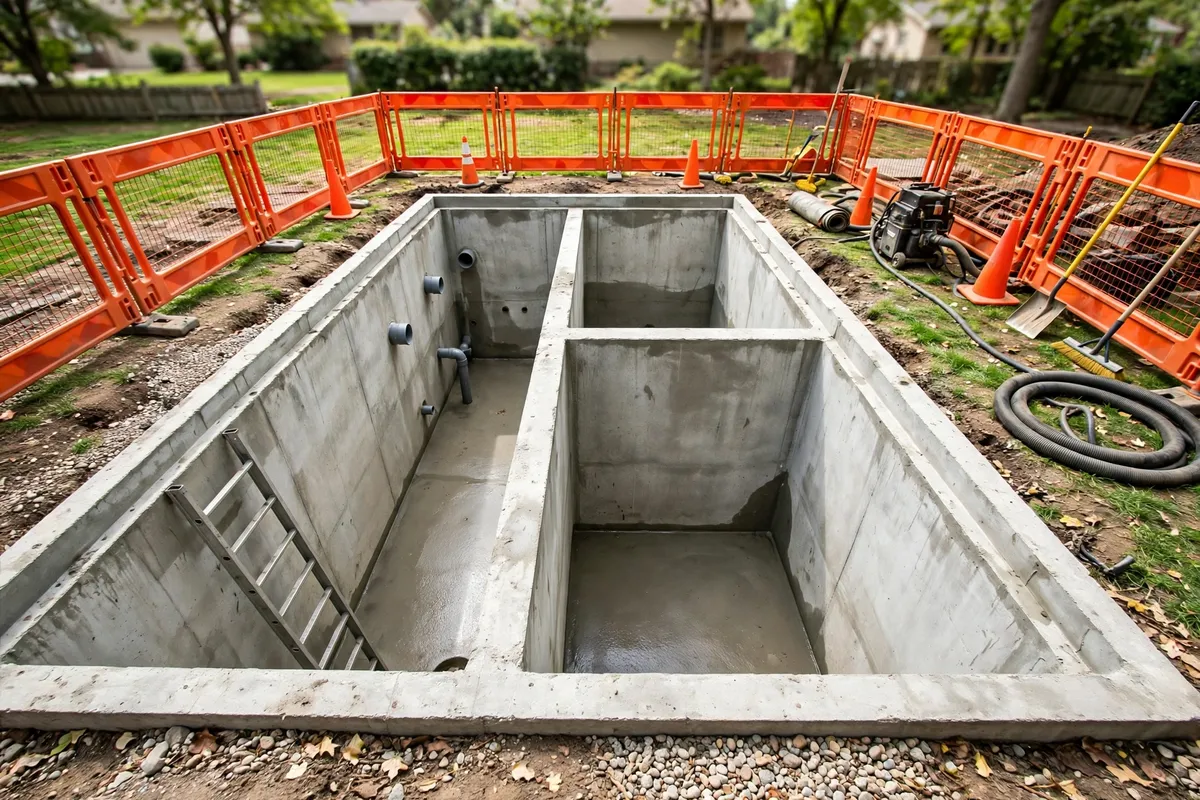
Pumping and cleaning sound like the same job, but they are not. A standard pump-out removes the liquid and loose solids from a tank that is on schedule. A septic tank cleaning Covington KY homeowners need for a neglected or long-overdue tank goes further: walls washed down, hardened sludge broken up, every compartment emptied, filter serviced.
This page explains when a cleaning is the right call instead of a routine pump-out, what the work actually includes, and what it costs. If your tank is on its regular 3-to-5-year cycle, you probably want our septic tank pumping page instead — a standard pump-out is the right (and cheaper) service for a tank that is on schedule.
Septic Tank Cleaning Covington KY: Pumping vs. Full Clean-Out
A pump-out removes the liquid and loose solids from the tank. A full cleaning does everything a pump-out does, then adds a high-pressure wash-down of the tank walls and baffles, breaks up compacted sludge on the floor, empties every compartment completely, and pulls and services the effluent filter. Think of pumping as an oil change and cleaning as the oil change plus a full detail.
The distinction matters because a standard pump-out on a neglected tank can leave the worst of it behind. When a tank goes many years past its due date, the sludge layer compacts into a dense mat and a thick crust forms on top. A vacuum hose pulls the liquid around it but leaves the compacted material — which is exactly the material most likely to clog the outlet and migrate toward the drain field.
Price follows the labor: a cleaning takes longer, uses more water for wash-down, and involves more hands-on work inside the tank, so it costs more than a routine pump-out. The gap is the extra hour or two of work, not a different truck.
When a Full Clean-Out Is Needed
A full clean-out is the right call whenever the tank's history is unknown or long overdue. The most common triggers: it has been seven or more years since the last pump-out, you just bought the house and the seller has no records, the previous owners clearly never serviced it, or the system has already backed up once.
Real-estate transfers are the other big trigger. Buyers are told to ask when it was last pumped and to get the receipt — and a seller who cannot answer usually ends up paying for a pump-out with a full inspection before closing. A cleaning at transfer time gives the buyer a known starting point and gives the seller a clean bill of health to hand over.
Two more situations call for it: after a backup that sent solids where they should not go, and when a tank is being taken out of service — for example, a property where an old structure was removed and the tank must be pumped and properly abandoned before new construction. In every case, the goal is the same: start from a truly empty, clean tank.
Comparing septic options? The Covington Septic Pumping homepage lays out all six of our services in one place.
What a Cleaning Includes Beyond Pumping
A full cleaning starts where a pump-out ends. Every compartment is pumped dry, then the walls, baffles, and tees get washed down with high-pressure water while the loosened material is vacuumed out. Compacted sludge on the floor gets broken up and removed rather than left for next time.
What it does not include: repairs. If the cleaning turns up a cracked baffle, a collapsed tee, or a damaged lid, that is separate work — see our septic tank repair page. A good tech shows you what they found and prices the fix on the spot instead of burying it in the cleaning bill.
- Both compartments fully emptied and washed — the second compartment is where neglected tanks hide their worst buildup.
- Effluent filter pulled, cleaned, and reinstalled — or replaced if it is cracked or warped.
- Inlet and outlet baffles (or sanitary tees) inspected for cracks, corrosion, and blockages like grease buildup at the inlet.
- Sludge and scum levels measured and recorded, so you have a baseline for the next service date.
- Tank structure checked for cracks, root intrusion at seams, and lid condition — with riser options quoted while everything is open.
What a Full Cleaning Costs
A full clean-out costs more than a standard pump-out because of the extra labor, wash-down water, and time on site. Standard pump-outs in the Covington area run $250 to $700; a cleaning typically lands above that band, with the premium reflecting an extra hour or two of hands-on work inside the tank.
What moves the number: how long the tank has been neglected (a ten-year-overdue tank with compacted sludge takes real work), tank size, whether the lids are buried, and whether the filter or baffles need replacement on top of the cleaning. A cleaning bundled with a real-estate transfer inspection — pump, clean, and inspect with a written report — generally falls in the $300 to $650 range for the inspection portion plus the cleaning labor.
The septic tank cleaning Covington KY calls we get most often fall into two buckets: the transfer cleaning ordered during a home sale, and the rescue cleaning for a tank that has not been serviced in a decade. Get the scope in writing before the work starts: pump-out and full clean-out should mean specific line items on the quote, not whatever the tech feels like doing. The cheapest quote that only pumps a neglected tank is not a bargain — it leaves the compacted sludge that causes the next backup.
Cleaning or Pumping: Which Does Your Tank Need?
Use the calendar. If the tank was pumped within the last 3 to 5 years and the system is behaving, book a standard pump-out — a full cleaning would be paying for work the tank does not need.
Book the cleaning if any of these are true: you do not know when it was last pumped, it has been more than about seven years, the house just changed hands, there has been a backup, or a previous pump-out left the tank still partly full of compacted material. When in doubt, ask the tech to measure the sludge depth first — the numbers make the decision for you.
One honest note: a cleaning fixes a dirty tank, not a failing system. If the drain field is the problem — sewage surfacing, backups that return weeks after pumping — no amount of tank cleaning restores a clogged field. That is a repair conversation, and a straight tech will tell you so before taking your money. When you call for septic tank cleaning Covington KY service, tell us the tank's history — or that there is none. That one detail decides the scope, the time on site, and the price.
Keeping a Cleaned Tank Clean
A freshly cleaned tank is a reset button — what you do next decides how long it lasts. Get back on the 3-to-5-year pumping cycle immediately, and put the next date on the calendar before the truck leaves the driveway.
Watch what goes down the drains. The fastest ways to refill a tank early are pouring cooking grease down the kitchen sink — it hardens into blockages at the inlet tee — flushing so-called flushable wipes, paper towels, and feminine products, and running a garbage disposal hard. None of these belong in a septic system, and every one of them shortens the interval.
Spread out heavy water use when you can. A tank needs quiet time for solids to settle; back-to-back laundry loads, long showers, and a dishwasher running at once can push solids toward the outlet faster than the tank can separate them. And skip the additives — as we explain on our pumping page, nothing you pour down the drain replaces removing solids with a truck.
The deep clean, up close
Inside a Full Clean-Out: Pumped, Washed, Inspected
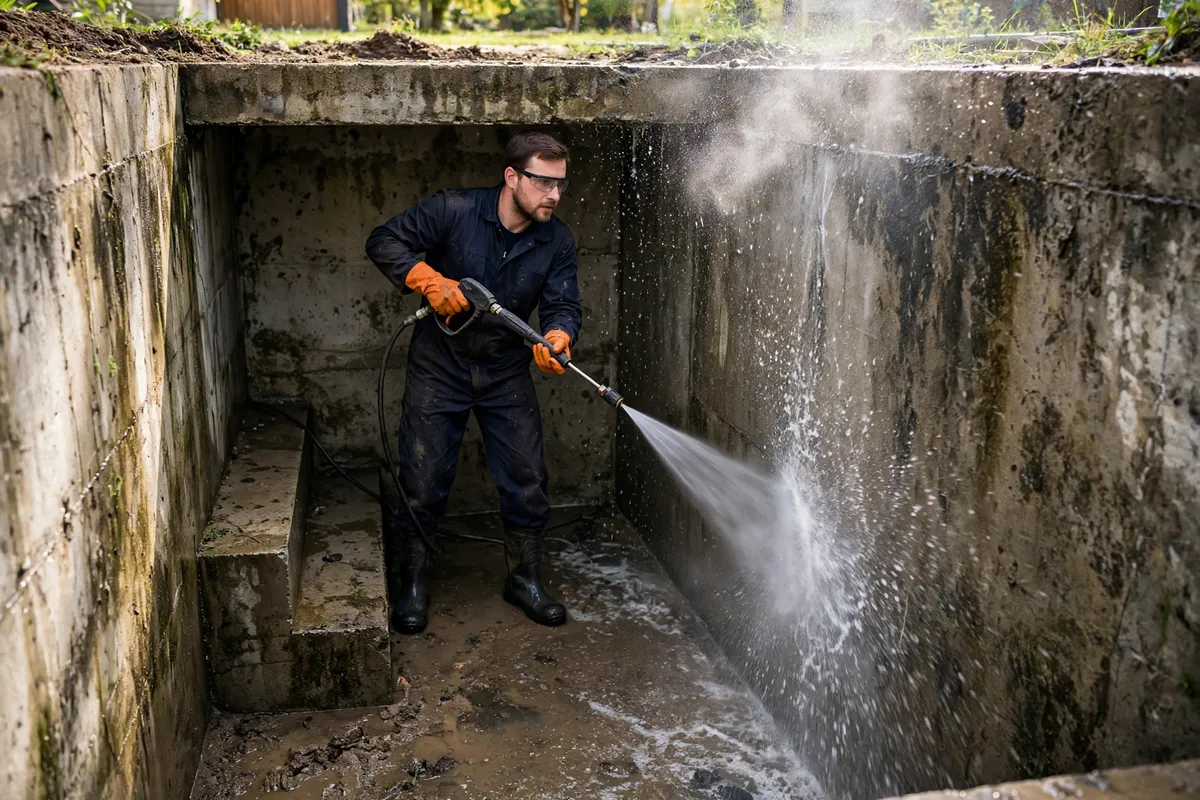
A full clean-out is pumping plus a wash-down. The truck pumps the tank dry like any pump-out — then, instead of closing the lids and leaving, the crew washes the inside of the tank down with pressurized water, breaking loose the compacted residue a vacuum hose can’t pull off the walls and floor, vacuums that out too, and inspects the clean interior before the lids go back on. Same truck as a pump-out. One extra, dirtier step — and it’s the step that resets a neglected tank to truly empty.
What pumping leaves behind
What stays behind is the difference. A quick pump-out mostly pulls the liquid layer and the floating scum; the heavy sludge that has compacted onto the tank floor, and the residue stuck to the walls, can survive it — the hose just can’t suck loose what has set up hard. That leftover mat is exactly the material most likely to clog the outlet and drift toward the drainfield. A thorough cleaning takes everything in the tank, not just what flows.
If you have never lived on septic, this is the part to understand: a pump-out removes what flows, a cleaning removes what settled. After a cleaning, the tank starts from empty, so the date on the record is a real baseline - keep it, note what never goes down the drain, and plan the next visit on the three-to-five-year rhythm rather than waiting for a slow drain to tell you.
The wash-down, step by step
Four steps: pumped dry, inspected empty, washed down, inspected clean.
- Pump it dry. Everything comes out first — liquid, scum, and sludge — same as any pump-out.
- Inspect it empty. With the tank open and empty, the crew gets a first look at the walls, baffles, and effluent filter.
- Wash it down. High-pressure water jets scour the walls and floor while the vacuum hose pulls the loosened residue out as it breaks free.
- Inspect it clean. Cracks, corrosion, and root intrusion at the seams only show up on a clean interior. This second look is the one that counts.
When the deeper job is the right call
Book the deeper service when drains are still slow — or odors are still hanging around — after a recent pump-out. Same answer for a tank that went years past due and now has sludge compacted hard on the floor, or an older system with buildup a vacuum hose alone won’t move. On a healthy tank, none of this is needed every visit; the full version is for every few cycles, or whenever the tank’s been neglected. What decides it on the day is measurement, not mood: once sludge and scum together take up about a third of the tank, it’s due — and measuring those layers is exactly what a septic system inspection does with the lids open.
One slow drain, or the whole house?
The split is how many fixtures are complaining. One slow fixture — a single toilet, one tub — points at that fixture’s own line, not the tank. A clog that clears and then comes back within a few weeks points the same way: grease, scale, or roots in the pipe. Every drain in the house slow at once is the tank talking, especially if it’s been years since the last pump-out. And if the lowest tub or toilet in the house is already backing up, skip the diagnosis — that’s emergency septic pumping, today.
| What you see | What it usually means | The right call |
|---|---|---|
| One sink or toilet drains slow; the rest of the house is fine | A clog in that fixture’s line | Snake or jet the line — the tank isn’t the problem |
| A clog that clears, then comes back within weeks | Grease, scale, or roots in the pipe | Camera look first, then hydro-jet the line |
| Every drain in the house slow at once | The tank is full | Pump the tank |
| Slow drains, sewage smell, and spongy ground over the field | A full tank pushing solids toward the field | Pump now — and have the field checked |
| Still slow right after a pump-out | Compacted residue left behind — or a line problem the pump-out never touched | The full clean-out, or line work — the split decides |
Diagnosis pattern: standard septic trade guidance. Your tech confirms it on site, with the sludge and scum layers measured and the lids open.
Hydro-jetting is for the pipes, not the tank
Jetting scours the inside of pipes with water at roughly 1,500 to 4,000 PSI — grease, sludge, scale, and roots in the line don’t stand a chance. But understand what it is: line work. A jetter doesn’t empty a tank, can’t mend a broken pipe, and won’t bring a failed drainfield back. And on old or fragile pipe, the crew should run a camera down first, to see what that water would be hitting before it hits it.
Pressure range: national trade guidance for line jetting.
Common questions
Frequently Asked Questions
Clean it first. A dirty or neglected tank is not a failed tank — a full clean-out restores it. Replacement is only on the table when the tank itself is structurally failing: cracked walls, collapsed baffles that cannot be replaced, or a steel tank rusted through. Most tanks we see need cleaning and maintenance, not replacement.
If you do not know when it was last serviced, if it has been more than about seven years, or if a previous visit left compacted sludge behind, you need the cleaning. A technician can also measure the sludge depth — thick, compacted layers that a standard pump-out will not fully remove mean it is cleaning time.
Yes — neglected tanks are exactly what full clean-outs are for. Expect it to take longer and cost more than a routine pump-out: compacted sludge has to be broken up and washed out, and the filter and baffles often need attention after that long. The alternative — leaving it — is a failed drain field, which costs far more.
Pumping removes the liquid and loose solids from a tank that is on schedule. Cleaning is the deeper service for neglected or overdue tanks: wash-down of walls and baffles, breakup of compacted sludge, every compartment fully emptied, and the effluent filter serviced. Same truck, more labor, more thorough result.
Both, done together. Ask the seller for a pump-out with a full inspection and a written report — and get the receipt. A cleaning gives you a known starting point, and the inspection tells you the condition of the tank, baffles, and drain field before you close. Also ask for any as-built records; they are public records available from the Northern Kentucky Health Department by open-records request.
Only if the tank was the cause. If drains speed up after the cleaning, the tank was full and you are done. If they slow down again within weeks, the drain field is likely failing and pumping or cleaning will never fix it — that needs a repair evaluation. A straight tech tells you which one you are dealing with.
Longer than a standard pump-out. Most residential clean-outs take a few hours on site, depending on tank size, how neglected it is, and whether the lids are buried. A tank that has not been serviced in a decade can take most of a morning. Your tech should give you a time estimate with the quote.
There’s no separate calendar for it. A healthy system just gets pumped on the normal cycle — every 3 to 5 years, per the EPA — and the deep version comes in when the tank has been neglected: sludge compacted over missed cycles, an older system with hard residue, or symptoms that didn’t quit after a pump-out. Think every few cycles, or whenever the tank’s history is unknown. What decides it on the day is measurement — once sludge and scum together reach about a third of the tank, it’s due either way.
No — jetting and tank work are different jobs that happen to share pressurized water. Hydro-jetting scours the inside of pipes: grease, scale, sludge, and roots in the line between the house and the tank, at roughly 1,500 to 4,000 PSI. The tank itself is serviced by pumping it dry and washing down its walls and floor. Jetting also doesn’t repair a broken pipe or revive a failed drainfield.
Yes — if you know where the tank sits, digging down to expose the access lids ahead of the visit can save you money; uncovering a lid usually means a hole roughly 18 by 18 inches. Leave the opening, pumping, and wash-down to the crew. And when they arrive, tell them about any slow drains, odors, or past backups you’ve noticed — that heads-up shapes the whole job.
Three things: the date on the record is your baseline, so keep it - the next buyer, tenant, or inspector will ask for it. Nothing but human waste and toilet paper goes down the drain - wipes, grease, and chemicals shorten the interval. And plan the next visit on the three-to-five-year rhythm instead of waiting for slow drains; a cleaned tank that is pumped on schedule stays clean.
Ready to Schedule Your Septic Service?
Call Covington Septic Pumping today. We show up on time, pump it fully, clean up, and honor the quoted price.
Call (615) 413-1746