Covington, KY Septic Service
Commercial Septic Pumping in Covington, KY
A business can't close for a septic backup. Scheduled pumping sized to your property's usage — measured, recorded, and done off-hours — keeps your system off your problem list.
- Pumping schedules set by measured sludge and scum — not guesswork
- Written service record after every visit, for your files
- Off-hours and early-morning visits that keep your doors open
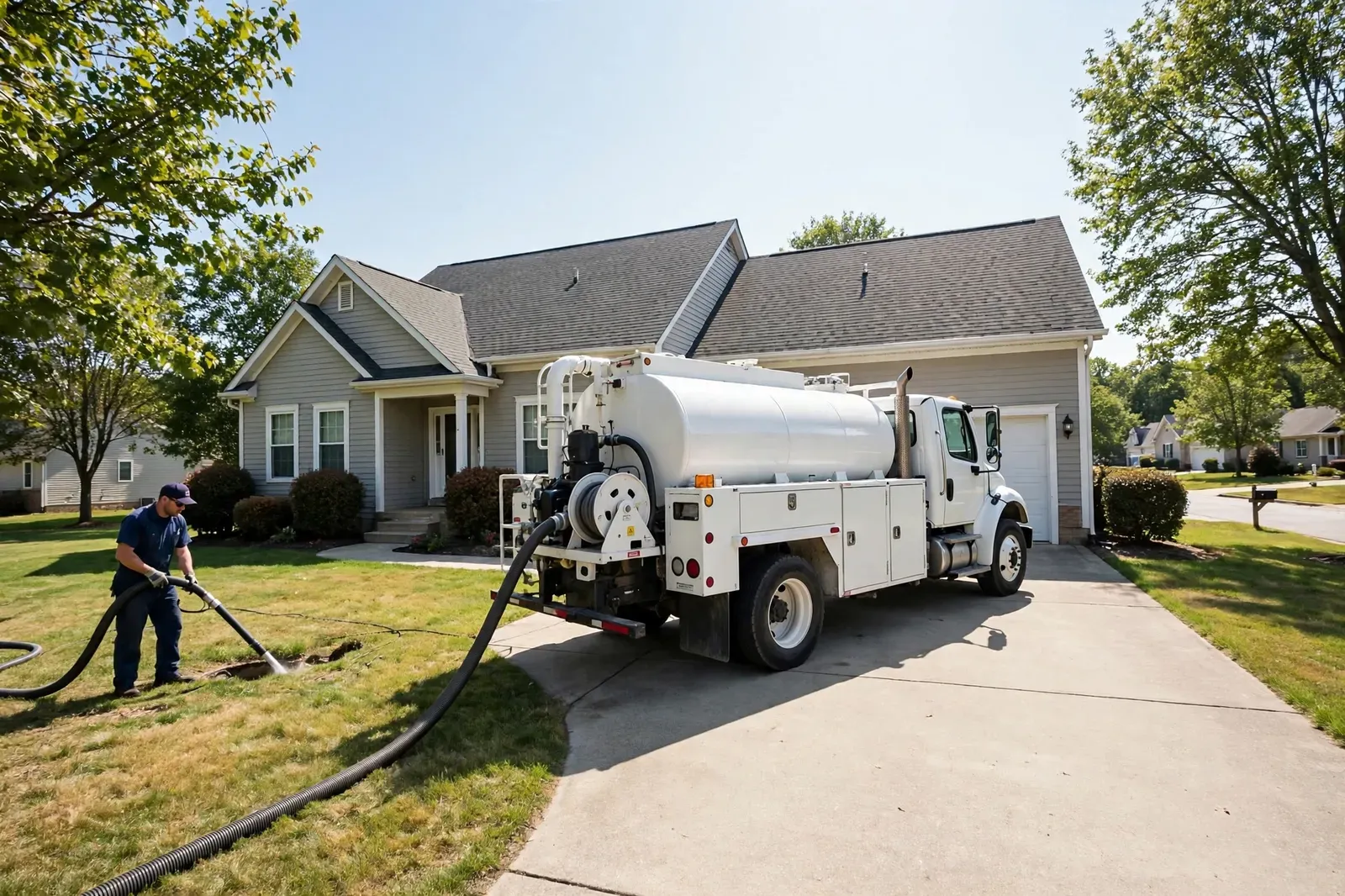
Commercial septic pumping is the same job as a home pump-out — a truck, a vacuum hose, and the sludge and scum physically removed from the tank — scaled up for a property that pushes far more water through its system than any house, and that can't afford a backup during business hours. In Covington and across Northern Kentucky, we pump commercial systems for restaurants, churches, schools, offices, retail buildings, multi-unit rentals, and warehouses, on programs sized to each property's actual usage.
This page explains how a commercial schedule gets set, what a visit includes, what it costs, and the records that come with it. If your property is residential, our septic tank pumping page covers the home version. If a commercial tank has been neglected for years, it may need a full clean-out first to reset it — compacted sludge doesn't leave with a routine pump-out.
Why a Commercial System Fills Faster Than a House
Volume. A septic tank collects solids in proportion to the water pushed through it, and a working property pushes a lot: the average person uses about 70 gallons of water a day, and a restaurant, school, or office multiplies that by every employee, customer, restroom, and kitchen fixture, every day it is open.
Kentucky's design rules build that reality in. Under 902 KAR 10:085, a commercial system's minimum tank capacity is its design daily flow plus 50% held back for solids storage — the state assumes a commercial tank accumulates solids fast relative to its size, because it does. The practical result: the EPA's familiar "pump every 3 to 5 years" is a residential baseline. A high-volume property can use up its solids allowance in a fraction of that time, and the only honest way to set its interval is measuring what is actually in the tank.
The pattern differs by property. A restaurant runs a heavy daily load, and its kitchen fats build the floating scum layer faster. A church sits quiet all week, then slams the system on Sunday. A school runs hard on weekdays and empties out for the summer. Multi-unit rentals are residential use multiplied by the number of households. The schedule has to match the pattern — which is why ours are set per property, not per template.
Who Books Commercial Pumping in Northern Kentucky
Any property on its own septic system that serves the public, houses tenants, or employs people — and any owner or manager who would rather hold a service record than explain a backup. The regulars:
- Restaurants and food service — the highest daily flow per seat, plus a state-required grease trap ahead of the system (more on that below).
- Churches and event spaces — quiet all week, slammed on weekends; the tank has to absorb the spike without complaint.
- Schools and daycares — heavy weekday use, and a summer break that is the natural service window.
- Offices and retail — steady employee and customer restroom load, five or six days a week.
- Multi-unit rentals and landlords — several households on one system, and records that matter at sale, refinance, or a health-department question.
- Warehouses and light industrial — smaller flows, but shift bathrooms and break rooms still fill a tank on a calendar nobody is watching.
New to a property and not sure what system it has? A septic system inspection locates the tank, measures the layers, and gives you the starting record everything else builds on.
What a Commercial Pump-Out Includes
The same disciplined sequence as any good pump-out, scaled to the property. Nothing exotic — the difference is that it happens on a schedule, with measurements, and with paperwork.
- Locate and expose the access lids — and note their position in your property file, so every future visit starts faster.
- Pump every compartment dry, working the scum and sludge loose with a mixing rod as the vacuum pulls, so the solids actually leave instead of settling back.
- Check the empty tank: walls for cracks, inlet and outlet baffles, and the effluent filter — the inexpensive parts that protect the expensive drainfield.
- Measure and record the sludge and scum levels, the tank's condition, and the date — the service record your files run on.
- Close up, clean up the work area, and set the next date from the measurements, not from a generic calendar.
Signs a Commercial System Is Overdue
The same warnings as a house, with worse timing: slow drains at several fixtures at once, gurgling in the lines, sewage odors indoors or around the tank, and wet, spongy ground — or suspiciously lush grass — over the drainfield.
On a commercial property those signs carry extra weight. A backup doesn't just ruin a morning; it closes bathrooms, and for a food or childcare business it can close the doors. Sewage surfacing in the yard is advanced drainfield trouble, and a high-water alarm sounding means the tank is full and a backup is what happens next. If sewage is already coming up through the drains, that is no longer a scheduling question — see emergency septic pumping. Everything short of that says the same thing: move the program date up. A tank pumped on evidence costs a pump-out. A tank pumped after a backup costs a pump-out plus the cleanup.
For owners & property managers
Pumping on a Program: Measured, Recorded, Repeatable
A pumping program is just a schedule with evidence behind it. Instead of a date guessed when the property changed hands, the interval comes from your system's design flow and from the sludge and scum measured at every visit — so each appointment is set by the last one's numbers, and the paperwork proving the system is maintained lands in your files the same day.
The interval is set by measurement, not the calendar
The rule is the same one that governs a home tank: pump when sludge and scum together reach about a third of the tank's volume. What changes commercially is how fast you get there — a busy property can reach the one-third mark years ahead of a house on the same size tank. That is why every program visit measures both layers before the lids go back on: the next visit's date is written from this visit's numbers, adjusted for how your property actually uses water.
What commercial pumping costs
Size is the biggest driver — the price follows the gallons on the truck. National cost data by tank size shows the pattern clearly, and most commercial tanks sit at the large end of it; properties with tanks in series are priced on total gallons across the system.
| Tank size | National pump-out range |
|---|---|
| 750 gallons | $250–$550 |
| 1,000 gallons | $325–$700 |
| 1,250 gallons | $375–$900 |
| 1,500 gallons | $450–$1,100 |
| 1,750 gallons | $550–$1,250 |
Ranges: Angi 2026 national cost data by tank size. Large commercial tanks and multi-tank systems are quoted per property — the quote you get before we roll is the price you pay.
What else moves the number: how overdue the tank is (sludge left for years compacts and takes longer to work loose), lid access, and whether the visit is a planned program stop or an emergency call. Nationally, an urgent after-hours pump-out typically totals roughly $600–$1,200 or more once the call-out premium lands — the expensive way to buy the same pumping.
The records side of the job
On-site systems in Northern Kentucky answer to the Northern Kentucky Health Department — NKHD, based in Florence, keeps the permit and as-built record for your system and has permitted and inspected local systems since 1982. A maintained property keeps its own parallel file: the date of every pump-out, the measured sludge and scum levels, the tank's condition, and where the waste was hauled. That file is what you hand a health inspector, a buyer, a lender, or a new property manager — it is the difference between "the system is maintained" as a claim and as a document.
Scheduled around your hours, not ours
A pump truck needs the parking lot, not your customers. Program visits are booked for early mornings, closed days, or the quiet end of your operating hours — a school pumped in July, a church pumped on a weekday, a restaurant pumped before the lunch setup. A routine pump-out takes about 30 minutes to a couple of hours depending on tank size and access, so most properties never have to close for one.
Common questions
Frequently Asked Questions
It depends on usage, not a universal calendar. The EPA’s 3-to-5-year interval is the residential baseline; a commercial property puts far more water through its system, so it fills its solids capacity faster. The working rule is measurement: pump when sludge and scum together reach about a third of the tank. A high-volume restaurant may need pumping far more often than a small office — the first visit measures the layers and sets the interval from your property’s numbers.
The price follows the tank. National cost data (Angi, 2026) puts pump-outs at roughly $250–$550 for a 750-gallon tank, $325–$700 for 1,000 gallons, $375–$900 for 1,250, $450–$1,100 for 1,500, and $550–$1,250 for 1,750 gallons. Larger commercial tanks and properties with tanks in series are quoted on total gallons, lid access, and how much solid has built up. Your quote is confirmed before work starts.
Yes — every visit ends with a service record: the date, the sludge and scum levels measured, the tank’s condition, and any problems found. Keep it with your property documents. On-site systems in Northern Kentucky are permitted through the Northern Kentucky Health Department, which keeps the system’s permit and as-built record, and your own pumping file is what demonstrates the system has been maintained.
That’s the normal way to do it. Program visits are scheduled for early mornings, closed days, or the quiet end of your operating hours so the truck never competes with your customers or tenants. Most pump-outs take about 30 minutes to a couple of hours, depending on tank size and access — most properties never close for one.
Yes. Kentucky’s design rules allow multiple tanks in series when one tank can’t provide the required capacity — the first tank must be at least 1,000 gallons — and properties built that way are serviced as one system: every compartment of every tank pumped on the same visit, priced on total gallons, and recorded as one service.
No — they’re separate components with separate jobs. Kentucky’s design rules (902 KAR 10:085) require food-service establishments to have an approved grease trap ahead of the system — at least 500 gallons at flows up to 6,000 gallons a day, 1,000 gallons above that — to keep kitchen fats out of the tank. This service covers the septic tank itself; the trap is its own maintenance item, and keeping it serviced is what stops the tank’s scum layer from building faster than the schedule expects.
Slow drains at several fixtures at once, gurgling in the lines, sewage odors indoors or around the tank, and soft, wet ground or unusually green grass over the drainfield. A high-water alarm sounding means the tank is already full. Any of these means the date should move up; sewage backing up or surfacing in the yard means the system needs attention now, not at the next scheduled visit.
The tank keeps collecting solids until sludge and scum crowd out the liquid layer — then solids wash into the drainfield and clog the soil, which is the most expensive failure a septic system can have. Along the way come the slow drains, the odors, and eventually a backup, usually at the worst possible hour; nationally, an emergency pump-out typically totals about $600–$1,200 or more once the after-hours premium lands, before any cleanup. Scheduled pumping is the same truck, bought on your calendar instead of theirs.
Ready to Schedule Your Septic Service?
Call Covington Septic Pumping today. We show up on time, pump it fully, clean up, and honor the quoted price.
Call (615) 413-1746